Winemaking calculators
for working cellars.
Sulfite additions, fermentation conversions, acid additions, and MLF estimates. Enter measurements, select units, and calculate on your device.
App Store release pending. The download will become available after Apple approves the app.
The calculations
One consistent workflow, with explicit input and result units. Results clear when measurements or units change.
| Calculator | What it does |
|---|---|
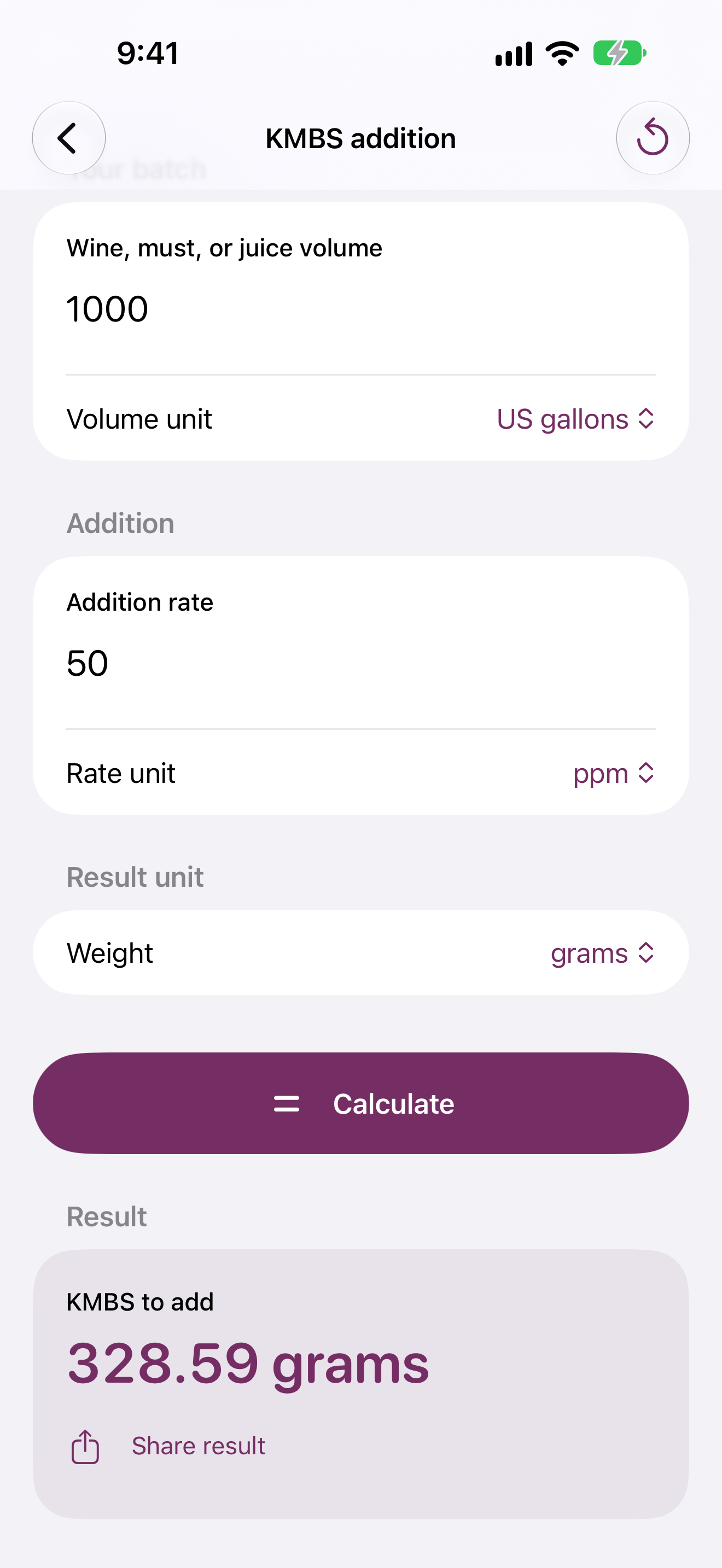
| KMBS addition | Calculate potassium metabisulfite by weight from batch volume and the SO₂ addition rate. Uses a 57.6% SO₂ yield. |
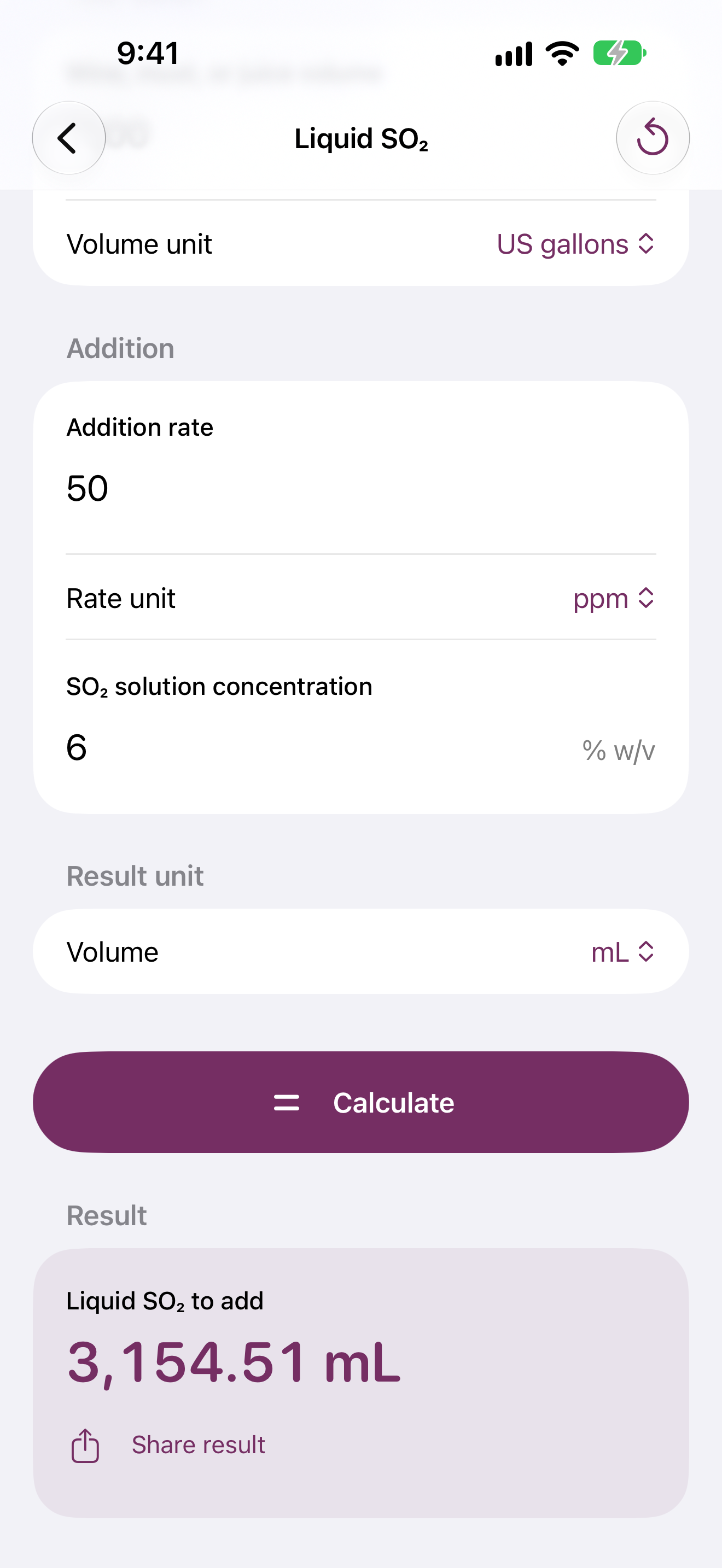
| Liquid SO₂ | Calculate the volume of a liquid SO₂ solution from batch volume, addition rate, and concentration in % w/v. |
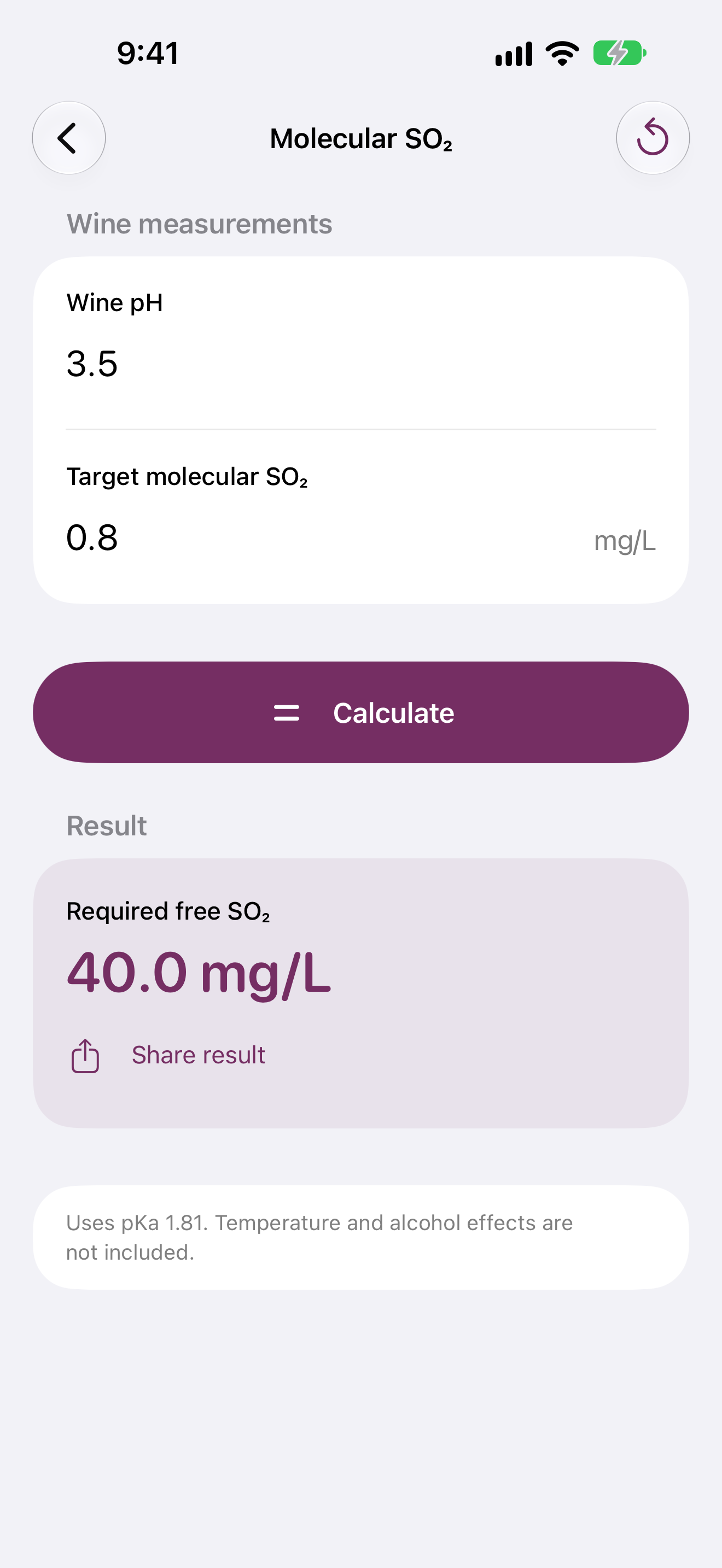
| Molecular SO₂ | Estimate required free SO₂ from wine pH and the desired molecular SO₂ level. Uses pKa 1.81. |
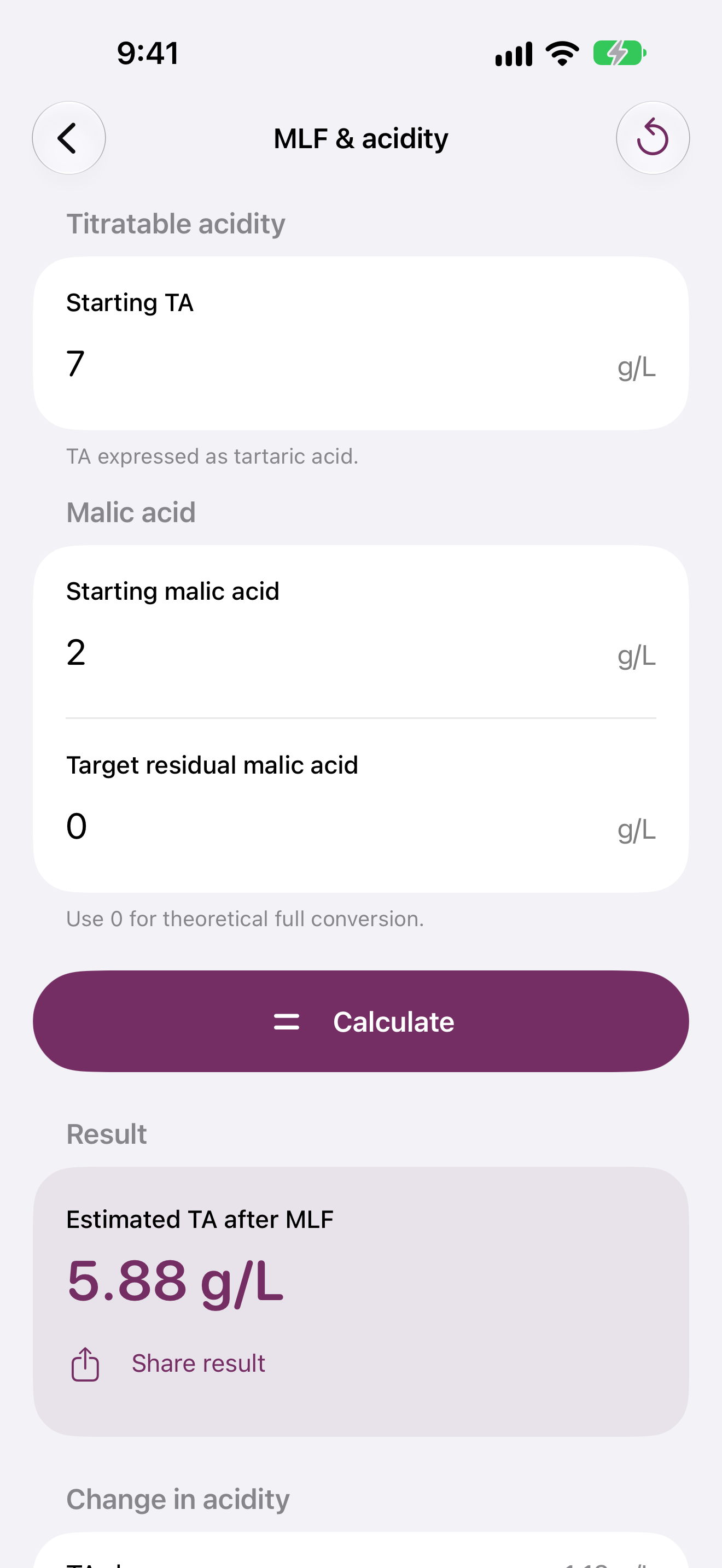
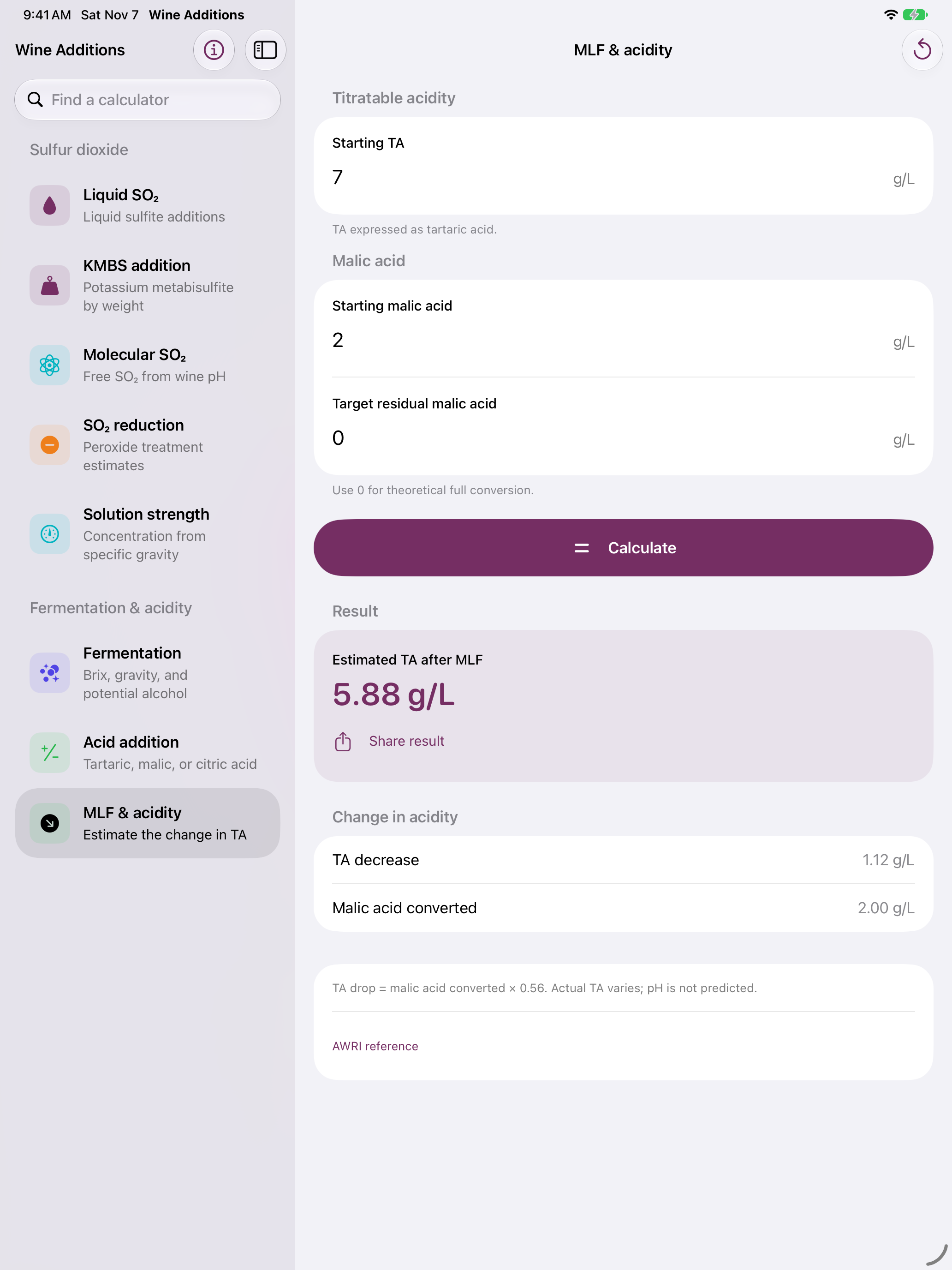
| MLF & acidity | Estimate the TA decrease and final TA from starting TA, starting malic acid, and a target residual malic acid. |
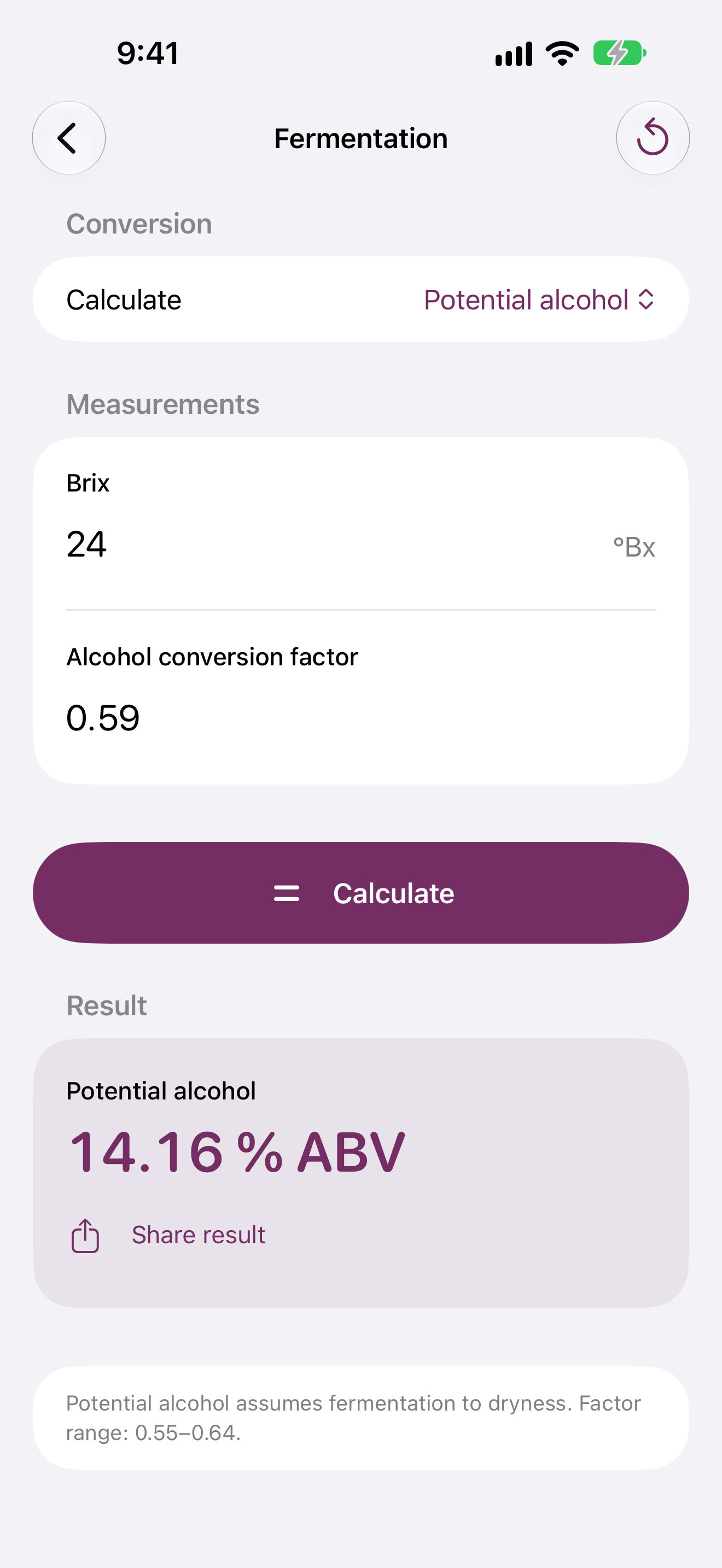
| Fermentation | Convert Brix to potential alcohol or specific gravity, and specific gravity to Brix. |
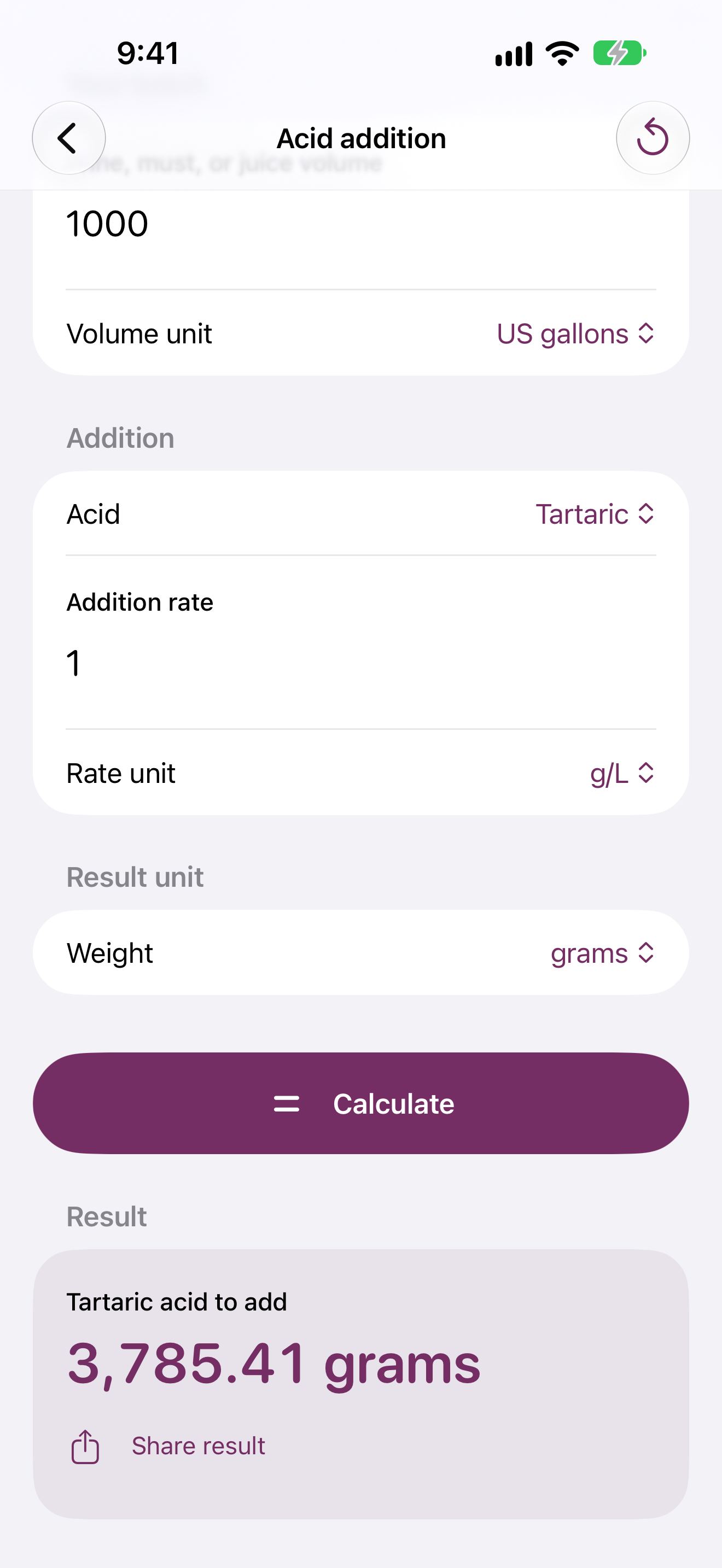
| Acid addition | Calculate the weight of tartaric, malic, or citric acid for a selected addition rate and batch volume. |
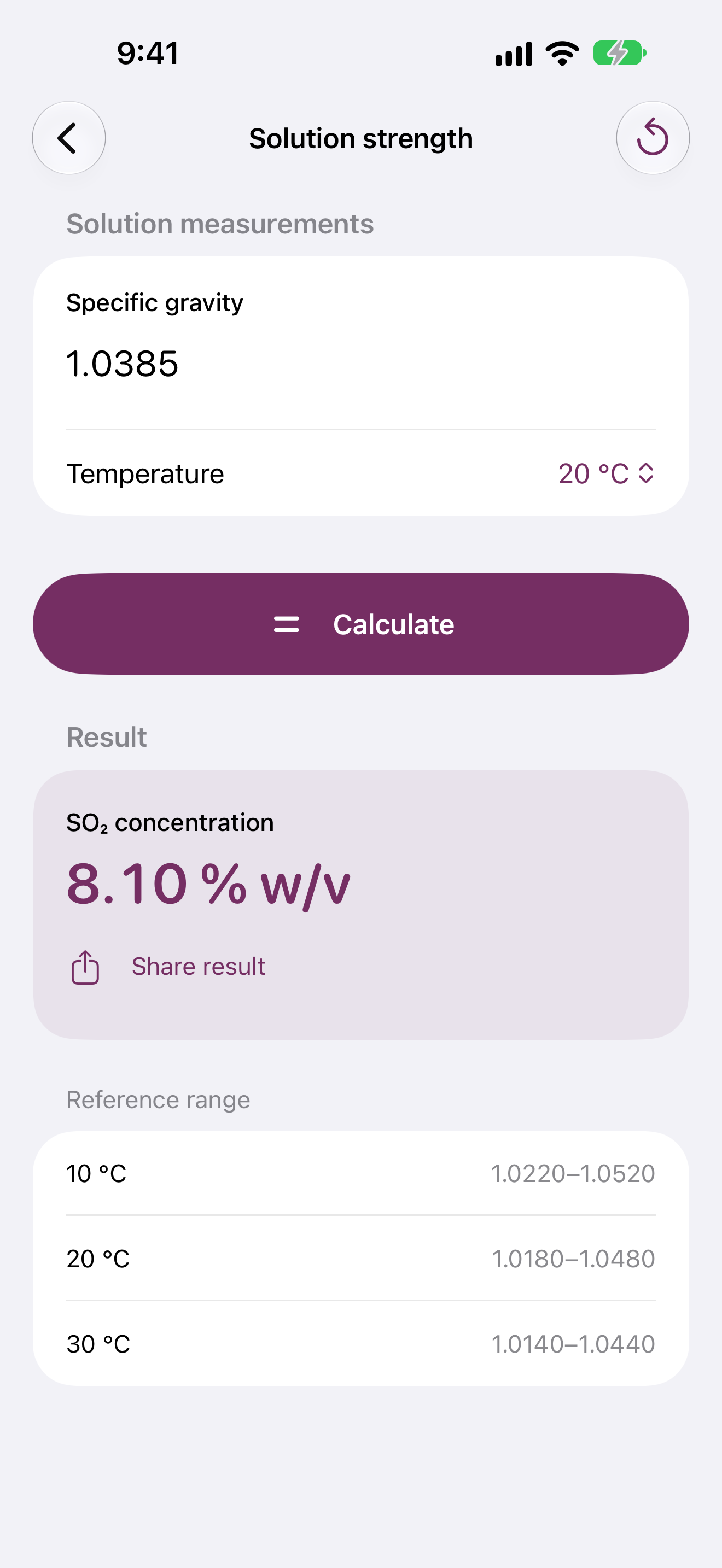
| Solution strength | Estimate SO₂ concentration from specific gravity at 10, 20, or 30 °C, within the 4–10% reference range. |
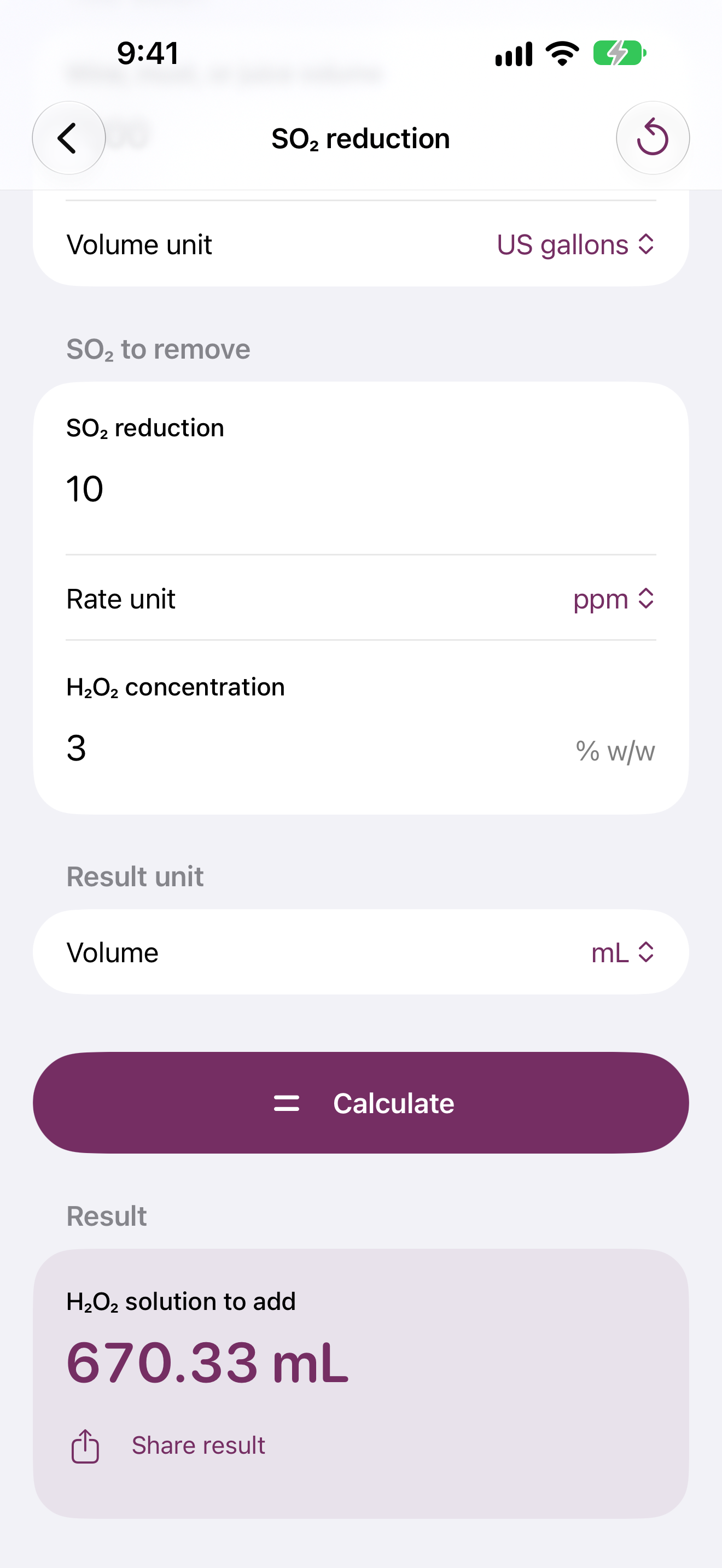
| SO₂ reduction | Estimate the volume of hydrogen peroxide solution needed for a selected SO₂ reduction, assuming solution density of 1 g/mL. |
MLF: estimate the change in TA
TA decrease = (starting malic − residual malic) × 0.56
TA is expressed as tartaric acid in g/L. Full conversion and partial conversion are supported.
- Starting TA
- 7.00 g/L
- Starting malic acid
- 2.00 g/L
- Target residual malic acid
- 0.00 g/L
- Estimated final TA
- 5.88 g/L
Theoretical estimate based on the Australian Wine Research Institute reference. Actual TA can vary. The calculator does not predict pH.
Actual app screens
iPhone calculators with demonstration measurements. Select an image to see it at full resolution.
On-device calculations
No account, advertising, analytics SDKs, or tracking. Calculation entries remain in app memory while it is running. Use the system share sheet when you want to send a result.
Units and assumptions
Batch volume supports US gallons, liters, hectoliters, and UK gallons. Addition-rate units include ppm, mg/L, g/L, g/hL, and g/100 mL. Liquid results and weight results have their own unit selectors.
These are calculation estimates. Confirm measurements and bench-test additions before treating a full batch. SO₂ addition rates do not guarantee a final free SO₂ level; acid addition weight does not predict final pH or TA.